
Nepal Formalises Vulture-toxic NSAIDs Restrictions
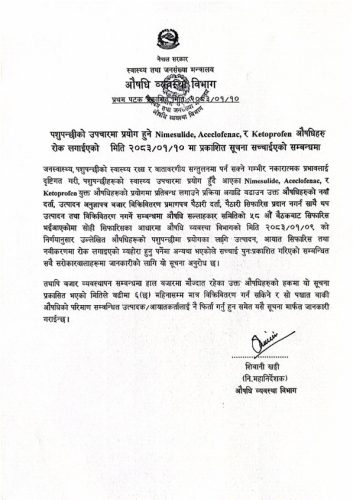
Nepal’s Department of Drug Administration (DDA) issued a formal prohibition notice of three vulture-toxic drugs: nimesulide, aceclofenac and ketoprofen on 23rd April 2026. Although the removal of these drugs from veterinary use, along with the earlier restrictions of diclofenac, has been top priority for the Vulture Safe Zone work across the country for over a decade, this regulatory back-up has been long awaited and is warmly welcomed by SAVE. The move is in direct response to the well-established threat that these drugs pose to the much depleted, but gradually recovering vulture populations in Nepal.
The decision was finalised during the 58th meeting of the Drug Advisory Committee (DAC), held in Kathmandu on 14 January 2026, but has now been formally circulated nationwide by Ms. Shiwani Khadgi, Acting DG of DDA. The dangers of these drugs have been known for some time and they are officially banned in neighbouring India and Bangladesh following extensive scientific publications backing up their toxicity. When livestock treated with these NSAIDs die, vultures feeding on their carcasses ingest the residues, leading to visceral gout, kidney failure and death.
This step has been a top priority for Nepal’s SAVE Partners as indicated in the regional SAVE Blueprint, and the regulatory breakthrough follows sustained advocacy led by Bird Conservation Nepal (BCN), with the crucially important lead from the Department of National Parks and Wildlife Conservation (DNPWC). The process (initiated over ten years ago for two of the drugs) has involved extensive inter-agency coordination, scientific consultation, and policy engagement.
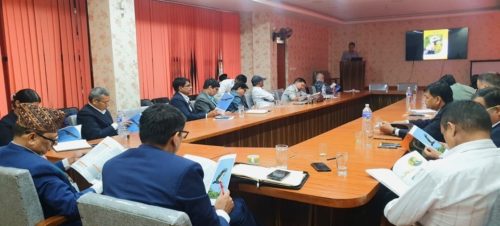
Nepal National Vulture Recovery Committee Meeting October 2023

DDA Office briefing meeting
Key milestones in this latest policy development in Nepal include:
October 4, 2023: The National Vulture Recovery Committee (NVRC) confirmed the ecological risks posed by the three NSAIDs.
October 12, 2023: The Department of National Parks and Wildlife Conservation (DNPWC) recommended regulatory action to the Ministry of Forests and Environment (MoFE), following consultations with BCN and stakeholders.
November 8, 2023: Secretary level meeting held at MoFE endorsed the recommendation.
November 9, 2023: MoFE escalated the issue to the Ministry of Health and Population (MoHP) through a follow-up letter.
April 1, 2024: A Secretary level meeting at MoHP formally instructed DDA to act.
May 4, 2025: A technical consultation at the DDA featured expert presentations on NSAID toxicity to vultures.
January 14, 2026: DAC unanimously approved the regulatory measures.
April 23, 2026: Formal notice issued on the DDA website.
The new directive issued on 23 April 2026 specifies:
- Production, import, new registrations, license renewals, and sales of the three NSAIDs are immediately prohibited.
- A six-month transition period has been granted to manage existing stock already in circulation.
- After this period, all unsold products must be returned to manufacturers.
During a stakeholder meeting held on 24th April, 2026 at DDA, in discussion regarding this directive, Ms. Shiwani Khadgi, Acting DG of DDA, emphasised that “non-compliance will be treated as a punishable offense under the Drug Act 1978. The authorities are committed to ensure adherence. However, the limited technical capacity among customs personnel may hinder effective monitoring and control”.
Adding to this, Ms. Ishana Thapa, Chief Executive Officer (CEO), BCN, stressed that “Despite the strong regulatory framework, enforcement remains a significant challenge. Nepal’s open and porous borders allow for the potential influx of unregulated veterinary drugs, often through informal trade channels.”
She pointed out that “these gaps could undermine conservation gains if not addressed, as continued availability of toxic NSAIDs poses an ongoing threat to vultures”.
Mr. Chris Bowden, RSPB Vulture Programme Manager & Globally Threatened Species Officer, who met with Acting DG, drew attention to the need for sustained and continuous efforts, highlighting that “ensuring the new veterinary drugs are registered only after rigorous testing for their safety for vultures, as stated in the Convention of Migratory Species Resolution 11.15 (Rev COP 14) is the only way to secure the vultures safety”. He further added that “incorporating such criteria into Nepal’s policy framework would further position Nepal as a leader in this sector”.
Nepal’s Vulture Conservation Plan (2023-2027), issued by the DNPWC and Department of Forests and Soil Conservation (DoFSC) under its objective 1 prioritises the prevention of toxic NSAID poisoning and the control of poisoned cattle carcasses, reinforcing the urgency of regulatory intervention.
In this regard, Dr. Buddhi Sagar Poudel, DG, DNPWC, stated that “The DDA’s action represents a crucial step towards maintaining the recovery of vultures in Nepal.” He further mentioned that “these efforts are closely aligned with Nepal’s Vulture Conservation Action Plan (2023-2027) and we affirm DNPWC’s continued commitment to supporting their implementation”.
Advocacy efforts led by BCN have demonstrated the power of coordinated action, and this latest policy decision further reinforces Nepal’s leadership in regional vulture conservation. However, the success will depend on effective enforcement, cross-border cooperation, and continued public awareness. It is also hoped that these steps will be formally gazetted in the near future, bringing further legal force from all Nepal’s ministries in the process of implementation of these important measures.
Compiled by Sadiksha Basnet & Chris Bowden