
Important SAVE Vulture Safe Zone criteria publication
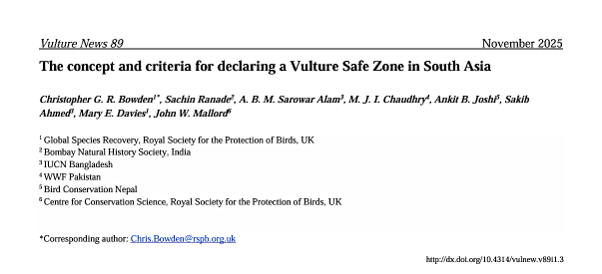
A recent publication in the journal ‘Vulture News’ has clearly set out the criteria for the establishment of a Vulture Safe Zone (VSZ) in the South Asia context.
The paper, authored by five of the SAVE partners describes two different routes that areas can be verified to certify their safety for vultures; either 1) through sufficient tracking data and survival rates of wild vultures in the area, or 2) tissue sampling of enough cattle carcasses to test for the presence of toxic NSAIDs – which are still regarded as the number one threat in the region.
The paper clarifies in statistical terms exactly how much information from each pathway is needed to confidently verify the safety – in simple terms this amounts to 50 vulture-years’ worth of tracking data, or 800 cattle carcasses sampled respectively. The paper goes on to suggest that these criteria, once satisfied, could potentially be used to declare formal designation in the form of an OECM – ‘Other Effective Area-based Conservation Measures’ – an increasingly used government gazetted status across India and other vulture range states.
It is hoped that the paper helps to focus VSZ activities by a range of vulture conservation organisations and local forest departments, recognising and quantifying the key threats that need to be addressed as a priority for the recovery of severely depleted vulture populations.
Meanwhile, a second publication from Bird Conservation Nepal (BCN) and RSPB, published in the prestigious journal Ibis, confirms the ongoing recovery of White-rumped Vulture populations in Nepal – a testament to the two decades of work carried out mainly by BCN, which has led to the declaration of the world’s first genuinely safe Vulture Safe Zone. The population recovery, from a low point in 2012, has been as rapid as it possibly could be for a long-lived species that has a maximum of a single chick per year. Modelling of the population showed that intrinsic demographic factors alone, especially high annual survival, adequately explains this rapid increase, with no evidence that populations in Nepal were being supplemented by immigration of birds from India. This follows the successful removal of diclofenac and other NSAIDs found to be toxic to vultures.
SAVE Chair Jemima Parry-Jones commented that “The Vulture Safe Zone concept has been at the centre of the conservation successes achieved by our SAVE partners. It is crucially important to document and publish the outcomes from years of dedicated efforts to provide a truly safe food source for the vultures, and to clearly describe how this work can be scientifically verified, rather than relying on concepts that may or may not have a lasting effect and are difficult to prove” .
Compiled by Chris Bowden & John Mallord